Storm damage cleanup
Removal of broken, hanging, and downed limbs after wind or snow, plus safe lowering of any branches lodged in the canopy where they could fall on people or property.
Serving Bend, OR · (541) 576-8764
Storm damage cleanup, hazard pruning, and cabling to save trees in Bend. Learn what tree removal repair covers and how Central Oregon weather drives the work.
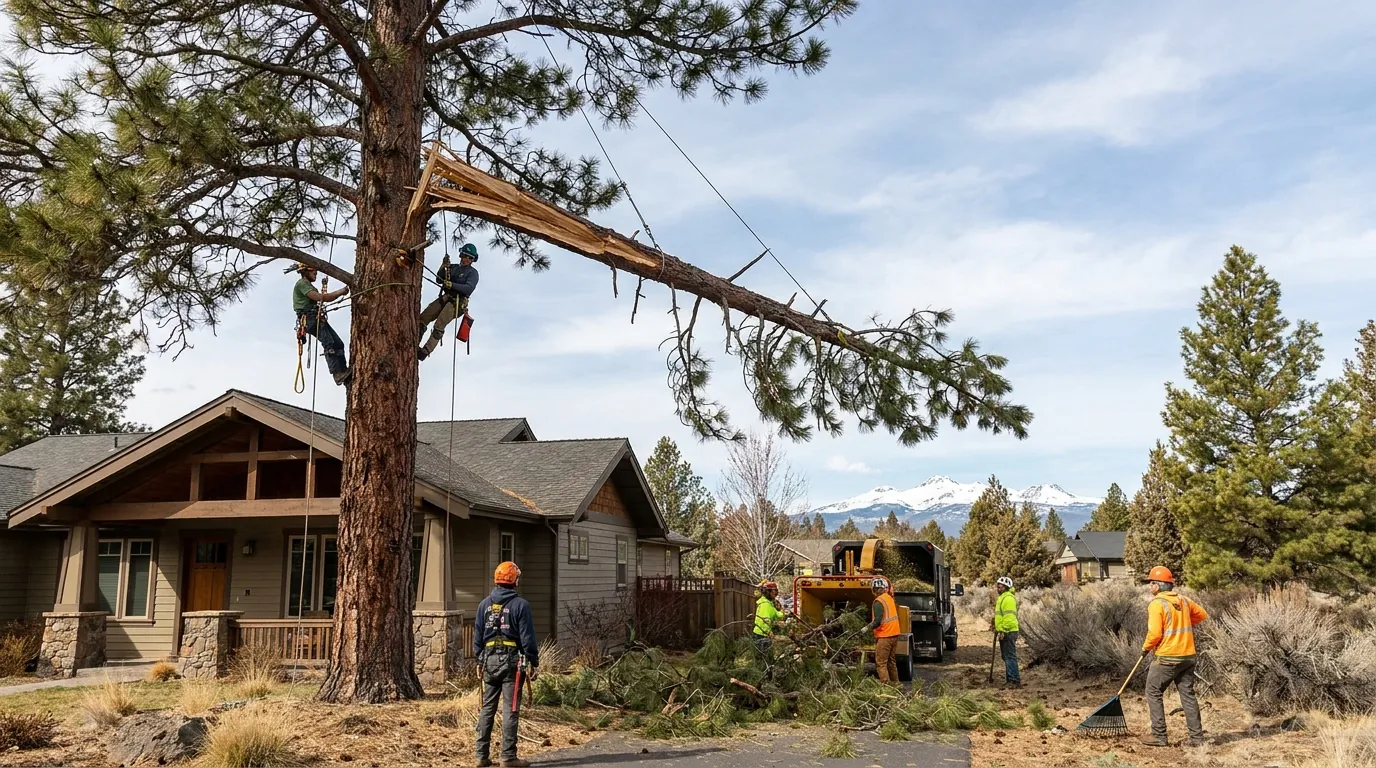
Not every damaged tree has to be taken out. Tree removal repair covers the work that sits between a healthy tree and a full removal: clearing broken and hanging limbs after a storm, correcting a split or torn union, cabling and bracing weak crotches, and doing the reduction pruning that keeps a stressed tree standing safely for a few more seasons. In Bend, most of this work follows wind. The gusts that funnel off the Cascades and across the High Desert snap out dead ponderosa tops and tear limbs from junipers, and the mess left behind is often more dangerous than the storm itself.
The warning signs that a tree needs repair rather than removal are usually mechanical, not biological. Look for a limb that has cracked but not fallen, a fresh split where two leaders meet, a hanging branch caught in the canopy, or a section of bark peeled back from an impact. If the trunk itself is sound and the roots are firm, these are repairable problems. If the damage runs into the main stem or the tree is already declining from beetle activity or drought, repair only delays a removal — and we will tell you that up front rather than sell you work that will not last.
Timing matters in our climate. Wounds made in the dry heat of late summer can dry out and stress a tree further, while cuts made in the cool, wet shoulder seasons tend to seal better. If a repair turns out not to be worth it, our tree removal service handles the takedown, and once the space is clear our tree removal installation work covers replanting with species better suited to Central Oregon.
Depending on the damage, a repair visit may include one or several of these.
Removal of broken, hanging, and downed limbs after wind or snow, plus safe lowering of any branches lodged in the canopy where they could fall on people or property.
Steel or synthetic cables installed high in the canopy to support weak unions and co-dominant leaders, reducing the chance of a split failing in the next windstorm.
Selective cuts that lower the tree's wind load and remove dead or cracked wood, easing stress on a compromised trunk while keeping the tree's structure intact.
Cleaning torn bark and ragged breaks to a smooth edge so the tree can seal the wound properly rather than leaving an entry point for decay and insects.
If you have a hanging limb, a split trunk, or debris in the canopy after a Bend windstorm, get it assessed before the next front comes through.
Serving Bend, Redmond, Sunriver, Eagle Crest, and nearby communities.
Often, yes, if the trunk is sound and the damage is limited to limbs or an upper union. Cabling, bracing, and reduction pruning can stabilize a tree and reduce its wind load for years. Whether it is worth doing depends on the tree's overall health, which we assess on site.
Small twigs and low branches on the ground are fine to clear. Hanging limbs, anything caught in the canopy, and branches near power lines are dangerous and should be left to someone with the equipment and training to lower them safely.
Sooner is better. A limb that is cracked but still hanging is a falling hazard, and the next round of High Desert wind can bring it down onto a roof, car, or person. A quick assessment tells you what needs urgent attention and what can wait.
No. Cables are installed to support the tree, not constrict it, and are placed high in the canopy where they take load off a weak union. They are checked periodically and are far less invasive than removing a tree that could otherwise stand safely.