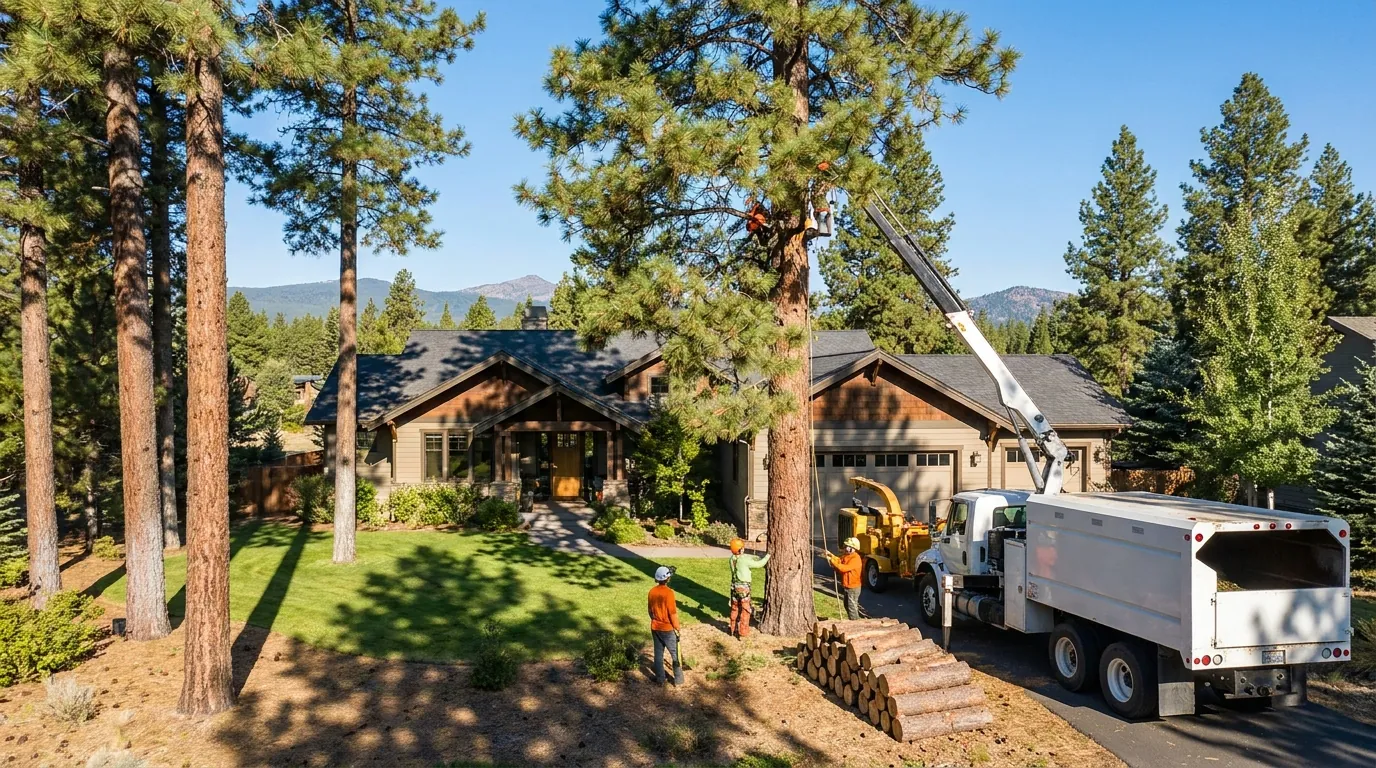
Tree removal
Full removal of dead, dying, leaning or hazardous trees, including tight-access takedowns near homes, fences and power lines where a tree cannot simply be felled in one piece.
Serving Bend, OR · (541) 576-8764
Bend Tree Solutions
Removal, trimming, stump grinding and storm response across Bend and Central Oregon.
Serving Bend, OR and the surrounding area.
Bend sits in a strange spot for trees. The west side catches wetter winters off the Cascades, the high desert east of town dries out hard by midsummer, and the volcanic soils underfoot shift from loose cinder to compacted ash within a single property line. Those details decide how a tree grows, how it fails, and whether removal is the safer call or the last resort. We write and work around those realities rather than treating every yard the same.
This site is for homeowners and property owners around Bend who have a tree raising questions — a leaning ponderosa over the driveway, a juniper crowding the house, a storm-split limb hanging over the deck, or a lot that needs clearing before a build. We cover the full range of work: tree removal, tree trimming, stump grinding, emergency tree service, lot and brush clearing, and tree health assessment when you are not sure a tree needs to come down at all.
The goal on every job is a clear answer: what is actually wrong, what the realistic options are, and what each one involves. No pressure to remove a healthy tree, and no guesswork on one that is genuinely unsafe.
Central Oregon's native stands are dominated by ponderosa pine, juniper and lodgepole, and each fails differently. Ponderosa hold moisture poorly in long droughts and can shed large limbs or snap at weak unions after a wet winter followed by a dry, windy summer. Juniper root shallow and wide in rocky volcanic soil, which makes them stubborn to remove and prone to tipping once the surrounding ground loosens. Lodgepole stands grow dense and spindly, so one failure often signals a cluster of at-risk trees nearby.
Soil matters as much as species. On loose cinder and pumice, root plates have less anchorage, so a tall tree with a modest lean is a bigger concern than the same lean in heavy, compacted ground. Where ash soils stay saturated through a west-side winter, root rot and ground softening change both whether a tree is stable and how safely equipment can work beneath it. We factor the ground, the slope and the season into every removal and tree health assessment.
Season sets the schedule, too. Winter storms and wet, heavy snow drive most of the urgent work; dry late-summer wind drives the limb drops. Planned trimming and clearing go best outside the peak fire-risk window, when fuel is dry and brush should not be sitting on the ground. We'll tell you when it makes sense to wait and when it does not.
Six core services covering the trees around your Bend property, from a single hazard removal to clearing an entire lot.
Full removal of dead, dying, leaning or hazardous trees, including tight-access takedowns near homes, fences and power lines where a tree cannot simply be felled in one piece.
Pruning for clearance, structure and health — raising canopies, thinning dense ponderosa and juniper, and removing deadwood before it drops.
Grinding stumps below grade so the ground can be replanted or reclaimed, including the surface roots that trip mowers and crack walkways.
Response for storm-damaged, split or fallen trees that threaten a structure, driveway or access, with safe stabilization and removal.
Clearing overgrown lots, brush and small-diameter growth for building, fire-fuel reduction and defensible space around homes.
A grounded look at a tree before you decide — signs of decay, root issues, lean and structural weakness — so removal is only the answer when it should be.
Practical answers to the questions we hear most in Bend, OR.
Practical guidance for Bend homeowners on comparing tree removal contractors, reading estimates, and avoiding the common pitfalls of hiring a crew.
A step-by-step look at how tree removal actually happens in Bend, OR — from the site assessment through felling, cleanup, and stump grinding.
How to tell when a tree on your Bend property has become a hazard — the warning signs of decay, lean, and root failure, and when removal is the safer call.
Tell us what you're seeing — a lean, a crack, deadwood, a storm split — and we'll walk through the real options for your property before anything gets cut.
Call to describe the tree and your location in or around Bend.
Based in Bend and serving the surrounding Central Oregon communities:
Both. Many trees that look alarming can be pruned, thinned or monitored rather than removed. We start with a tree health assessment and recommend removal only when the structure, decay or lean makes it the safer call.
We work throughout Bend and nearby communities including Sunriver, Eagle Crest, Redmond, Three Rivers, Crooked River Ranch and Black Butte Ranch. If you're close to that area, ask and we'll confirm.
Volcanic soils, long dry summers and wet west-side winters change how ponderosa, juniper and lodgepole grow and fail. Those local conditions drive our decisions on stability, timing and removal method.
Planned trimming and clearing usually go best outside the peak fire-risk window, so cut brush isn't sitting dry on the ground. Urgent storm or hazard work is handled whenever it is needed.
Yes. Stump grinding takes the stump below grade and addresses surface roots so the area can be replanted or reused. It can be scheduled with the removal or as a separate visit.